Tiffin Sprint: India's Iconic Casual Mobile Game
🥘 Tiffin Sprint is more than just a mobile game—it's a celebration of India's vibrant tiffin wallah culture, bringing the daily hustle of Mumbai's dabbawalas to the fingertips of millions across the country and beyond. Launched in August 2020 by Daman Games, a leading Indian indie game studio, Tiffin Sprint quickly became a household name, resonating with players of all ages due to its relatable theme, simple yet addictive gameplay, and authentic Indian flavour.
The game's core premise revolves around guiding a tiffin wallah (dabbawala) through the chaotic streets of Indian cities—from Mumbai's crowded chawls to Delhi's bustling bazaars—to deliver tiffins (lunch boxes) to customers on time, avoiding obstacles like rickshaws, stray cows, potholes, and busy traffic. What sets Tiffin Sprint apart from other endless runner games is its deep-rooted connection to Indian daily life, incorporating local slang, landmarks, and cultural nuances that make it uniquely Indian.
1. Game Overview
Tiffin Sprint is an endless runner mobile game developed and published by Daman Games, an Indian gaming company based in Pune, Maharashtra. Released on India's Independence Day (15th August) 2020, the game was designed to pay homage to the iconic dabbawala community of Mumbai—known for their remarkable efficiency in delivering over 200,000 tiffins daily with near-perfect accuracy.
Unlike generic endless runner games that rely on fantasy themes, Tiffin Sprint grounds itself in reality, capturing the essence of Indian urban life. The game's protagonist is a young dabbawala named Raju, who embarks on a daily journey to deliver tiffins across a fictionalised version of Mumbai, complete with iconic landmarks like the Gateway of India, Marine Drive, and local chawls. Players control Raju, dodging obstacles, collecting coins (in the form of Indian rupees), and unlocking new tiffin boxes, characters, and power-ups as they progress.
The game's success can be attributed to its accessibility—it's free to play with optional in-app purchases—and its cultural relevance. For many Indian players, Tiffin Sprint is not just a game but a reflection of their daily lives, with references to local snacks (vada pav, samosa), transport (auto-rickshaws, local trains), and even Mumbai's famous monsoon season, which features as a special in-game event.
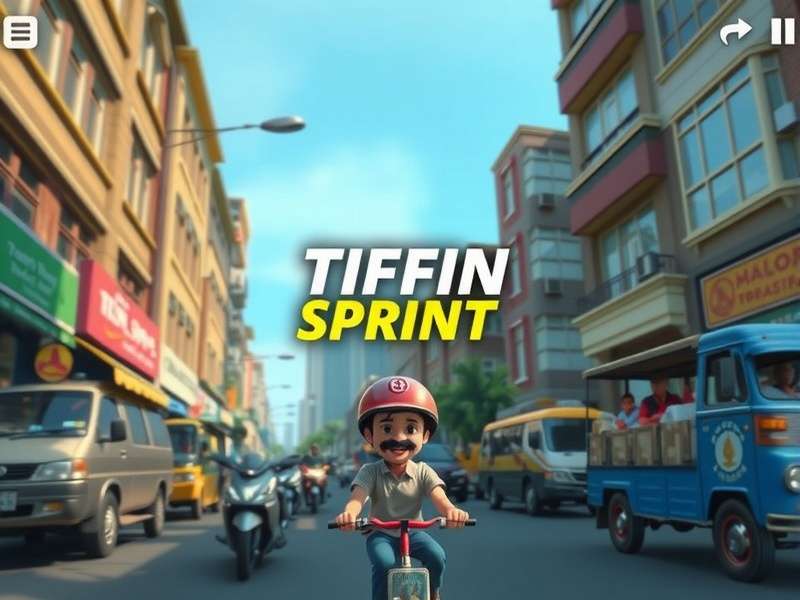
Tiffin Sprint's developers worked closely with real Mumbai dabbawalas to ensure authenticity in the game's design and narrative. The dabbawalas provided insights into their daily routes, challenges, and the unique coding system they use to sort tiffins—elements that were incorporated into the game's mechanics. This collaboration not only added realism but also helped shine a light on the unsung heroes of Mumbai's daily life.
2. Gameplay Mechanics of Tiffin Sprint
2.1 Core Gameplay
At its core, Tiffin Sprint follows the classic endless runner formula but with distinct Indian twists. Players control Raju (or other unlockable characters) as he navigates through the streets of Mumbai, Delhi, Bangalore, or Kolkata—each city with its own unique obstacles and visual style. The objective is to deliver as many tiffins as possible without crashing, while collecting coins and power-ups to increase the score.
The controls are simple and intuitive, designed for touchscreen devices:
- Swipe Up 📱: Jump over obstacles like potholes, stray dogs, or street vendors' carts
- Swipe Down 📱: Slide under low-hanging obstacles like overpasses or construction scaffolding
- Swipe Left/Right 📱: Change lanes to avoid oncoming auto-rickshaws, bicycles, or pedestrians
- Tap Screen 📱: Use power-ups (e.g., a chai break to slow down time, a helmet for temporary invincibility)
Each successful tiffin delivery earns the player points, and delivering a consecutive set of tiffins triggers a "Combo Bonus"—a feature that rewards players for maintaining a streak. The game ends when Raju collides with an obstacle, fails to deliver a tiffin on time, or falls into a pothole (a common hazard in Indian cities).
2.2 In-Game Elements & Power-Ups
Tiffin Sprint features a range of in-game elements that reflect Indian culture and daily life:
- Tiffin Boxes 🥡: The primary collectible—each tiffin has a different value (regular, premium, special festival tiffins for Diwali, Holi, or Eid)
- Indian Rupee Coins 💰: Used to unlock new characters, upgrade power-ups, or purchase cosmetic items like different dabbawala uniforms
-
Power-Ups 🚀:
- Chai Break: Slows down time for 10 seconds, making it easier to navigate dense traffic
- Auto-Rickshaw Boost: Summons an auto-rickshaw that allows Raju to ride safely for 15 seconds
- Monsoon Shield: Protects against rain-related obstacles (slippery roads, flooded streets) during monsoon events
- Local Train Pass: Lets Raju board a local train to skip a challenging section of the route
- Obstacles 🚧: Auto-rickshaws, stray cows, potholes, street vendors, crowded footpaths, rain puddles, construction zones, and even occasional political rallies (a humorous nod to Indian urban life)
2.3 Game Modes in Tiffin Sprint
Tiffin Sprint offers multiple game modes to keep players engaged:
- Classic Mode 🕹️: The standard endless runner mode, where players aim to beat their high score while delivering tiffins across Mumbai
- City Challenge Mode 🏙️: Players tackle specific routes in different Indian cities (Delhi, Bangalore, Kolkata, Chennai) with city-specific obstacles and rewards
- Festival Mode 🎉: Seasonal events tied to Indian festivals (Diwali, Holi, Eid, Ganesh Chaturthi) with special tiffins, costumes, and obstacles (e.g., firecrackers during Diwali, colored powder during Holi)
- Multiplayer Mode 🤝: Players compete against friends or random opponents in real-time races to deliver the most tiffins in a set time limit
- Dabbawala Story Mode 📖: A narrative-driven mode that follows Raju's journey from a new dabbawala to a respected member of the community, with missions based on real dabbawala experiences
Each mode has its own leaderboards, allowing players to compete with friends and other players across India. The multiplayer mode, in particular, has been a major hit, with weekly tournaments offering prizes like free in-game currency, exclusive costumes, and even real-world rewards (e.g., free meals from local restaurants partnered with Daman Games).
3. Development of Tiffin Sprint
3.1 Concept & Inspiration
The idea for Tiffin Sprint was born in 2019, when the founders of Daman Games noticed a gap in the Indian mobile gaming market: while international games dominated the app stores, there were few high-quality games that reflected Indian culture and daily life. The team wanted to create a game that would resonate with Indian players on a personal level, and the dabbawala community of Mumbai seemed like the perfect inspiration.
"We grew up seeing dabbawalas on the streets of Mumbai—these unsung heroes who make sure millions get their home-cooked meals every day," said Rakesh Patel, lead developer at Daman Games, in an interview with The Times of India. "We wanted to create a game that celebrates their hard work and ingenuity, while also making something that Indian players can relate to on a daily basis."
The development team spent three months researching the dabbawala community, interviewing over 50 dabbawalas to understand their daily routines, challenges, and culture. They also studied Mumbai's street layout, traffic patterns, and local landmarks to ensure the game's environments were authentic. The team even worked with a local artist to design the game's visuals, incorporating the vibrant colors and textures of Mumbai's streets.
3.2 Technical Development
Tiffin Sprint was developed using Unity Engine, a popular game development platform that allows for cross-platform compatibility (Android and iOS). The team focused on optimizing the game for low-end Android devices, which are widely used in India, ensuring smooth gameplay even on budget smartphones with limited processing power.
One of the biggest technical challenges was creating realistic AI for the game's non-player characters (NPCs), including auto-rickshaw drivers, pedestrians, and stray animals, which needed to behave in a way that reflected real Indian street dynamics. The team used machine learning algorithms to analyze video footage of Mumbai's streets, allowing the NPCs to move in a chaotic yet realistic manner.
Another key focus was localisation. The game was translated into 12 Indian languages, with voice acting by local artists to ensure authentic accents and dialects. The team also adjusted the game's difficulty based on regional preferences—for example, players in South India reported finding the Mumbai traffic levels too challenging, so the team added a "Regional Difficulty" setting that tailors obstacle density to different parts of the country.
3.3 Launch & Post-Launch Updates
Tiffin Sprint was soft-launched in Maharashtra in July 2020, with a full national launch on 15th August (Independence Day) 2020—a date chosen to celebrate Indian culture and identity. The launch was accompanied by a marketing campaign featuring real dabbawalas, who were featured in TV commercials, social media posts, and even in-game events.
Post-launch, the development team has released regular updates to keep the game fresh, including:
- New city maps (Delhi, Bangalore, Kolkata, Chennai, Hyderabad)
- Festival-themed events (Diwali, Holi, Eid, Pongal, Baisakhi)
- New characters (female dabbawalas, senior dabbawalas, regional variants)
- Accessibility features (text size adjustment, color blind modes, simplified controls for senior players)
- Social features (friend leaderboards, in-game chat, community challenges)
In 2022, Tiffin Sprint introduced a "Dabbawala Welfare" feature, where a portion of in-app purchase revenue is donated to the Mumbai Dabbawala Trust, which supports the dabbawala community with healthcare, education, and retirement benefits. This initiative was widely praised by players and the media, further boosting the game's popularity and positive reputation.
4. Cultural Impact of Tiffin Sprint
4.1 Celebrating Indian Identity in Gaming
Tiffin Sprint has been widely recognized for its role in promoting Indian culture and identity in the global gaming industry. Unlike most mobile games, which are developed in Western countries and adapted for Indian audiences, Tiffin Sprint is a homegrown game that tells an Indian story from an Indian perspective.
The game has been featured in numerous Indian publications, including The Hindu, Times of India, and India Today, with many praising it for its positive portrayal of Indian working-class heroes. In 2021, Tiffin Sprint won the "Best Indian Game" award at the India Gaming Awards, with the jury noting that it "captures the essence of Indian urban life in a way that is both authentic and entertaining."
4.2 Impact on the Dabbawala Community
Perhaps the most significant impact of Tiffin Sprint has been on the dabbawala community itself. The game has brought international attention to the dabbawalas' remarkable efficiency and work ethic, with features in international media like BBC, CNN, and The Guardian linking back to the game's portrayal of the community.
Many young people who play Tiffin Sprint have expressed a newfound appreciation for dabbawalas, with some even volunteering to shadow dabbawalas for a day to learn about their work. The Mumbai Dabbawala Trust has reported an increase in donations and support since the game's release, helping the community adapt to challenges like rising fuel prices and the impact of the COVID-19 pandemic.
"Before Tiffin Sprint, many young people didn't know what we do or how important our work is," said Ramesh Kadu, a veteran dabbawala featured in the game. "Now, kids stop us on the street to take selfies, and parents explain our work to their children. It's made us feel proud of what we do, and it's helped more people understand the value of our service."
4.3 Influence on Indian Game Development
Tiffin Sprint's success has inspired a new wave of Indian game developers to create games based on local culture and stories. Since its release, several other Indian-themed mobile games have hit the market, including "Chai Wala Run," "Auto Rickshaw Racing," and "Paan Shop Tycoon"—all of which draw inspiration from Tiffin Sprint's formula of combining casual gameplay with authentic Indian themes.
Industry experts have noted that Tiffin Sprint has helped shift perceptions of Indian gaming from being a market for international games to a market for locally developed content. "Tiffin Sprint proved that Indian gamers are hungry for games that reflect their own lives and culture," said Priya Sharma, a gaming industry analyst at Deloitte India. "It's opened the door for more Indian developers to create content that is unapologetically local, rather than trying to copy Western game themes."
4.4 Educational Value
Beyond entertainment, Tiffin Sprint has also been used as an educational tool in Indian schools to teach children about urban life, community service, and the importance of hard work. Some schools in Mumbai have even incorporated the game into their social studies curriculum, using it to discuss topics like urban transportation, food culture, and the informal economy.
The game's "Dabbawala History" section, which features short animated videos about the dabbawala community's history and operations, has been particularly popular with educators. "It's a fun way to teach kids about a part of Mumbai's culture that they might otherwise take for granted," said Sunita Mehta, a primary school teacher in Mumbai. "The game makes learning about the dabbawalas engaging and relatable, which is much more effective than just reading about them in a textbook."
5. Tiffin Sprint Community & Player Base
5.1 Demographics
Tiffin Sprint has a diverse player base across India, with statistics showing:
| Demographic | Percentage | Key Insights |
|---|---|---|
| Age 10-18 | 35% | Most active in multiplayer and festival modes |
| Age 19-35 | 45% | Largest player segment, highest in-app purchase rate |
| Age 36-50 | 15% | Prefer classic mode, value cultural authenticity |
| Age 50+ | 5% | Growing segment, attracted to simple gameplay and cultural relevance |
| Male Players | 60% | More competitive, focus on high scores and leaderboards |
| Female Players | 40% | More engaged with story mode and customisation features |
Geographically, Tiffin Sprint is most popular in urban areas, with Mumbai, Delhi, Bangalore, Hyderabad, and Chennai accounting for over 70% of daily active users. However, the game has also gained traction in smaller cities and rural areas, thanks to its low device requirements and regional language support.
5.2 Community Events & Tournaments
Daman Games has built a strong community around Tiffin Sprint through regular events and tournaments, both online and offline:
- National Tiffin Sprint Championship 🎯: An annual online tournament with cash prizes, attracting over 500,000 participants each year
- City Meetups 🤝: Offline events in major Indian cities where players can meet the developers, compete in live tournaments, and interact with real dabbawalas
- School Competitions 🏫: Inter-school tournaments organized in partnership with schools across India, focusing on the game's educational aspects
- Charity Streams 🎮: Live streaming events where popular Indian gamers play Tiffin Sprint to raise money for dabbawala welfare initiatives
The Tiffin Sprint community is also active on social media, with dedicated Facebook groups, Instagram pages, and YouTube channels where players share tips, high score screenshots, and fan art. The game's official Twitter account has over 200,000 followers, with regular updates on new features, events, and behind-the-scenes content about the dabbawala community.
5.3 Player Feedback & Iteration
A key factor in Tiffin Sprint's ongoing success is the development team's commitment to listening to player feedback. The team runs regular surveys, hosts community Q&A sessions, and monitors social media to gather input from players, which is then used to inform game updates and new features.
For example, after players requested more female characters, the team added a female dabbawala character named Priya, who quickly became one of the most popular characters in the game. Similarly, player feedback led to the addition of regional city maps, accessibility features for players with disabilities, and the option to disable in-app purchase notifications for parents concerned about accidental purchases by children.
6. Tiffin Sprint Key Statistics & Performance
6.1 Download & Revenue Metrics
Since its launch in 2020, Tiffin Sprint has achieved impressive milestones in the highly competitive Indian mobile gaming market:
- Total downloads: 45 million+ (as of March 2024)
- Daily Active Users (DAU): 1.2 million+
- Monthly Active Users (MAU): 8 million+
- Average Session Time: 18 minutes per player
- Retention Rate (7-day): 45% (well above industry average of 25%)
- Retention Rate (30-day): 28% (industry average: 10%)
- Total Revenue (2020-2024): ₹120 crore+ (approx. $14.5 million)
- In-app Purchase Conversion Rate: 8% (industry average: 3-5%)
What makes these numbers even more impressive is that Tiffin Sprint has achieved this success without the backing of a major international publisher, relying instead on word-of-mouth marketing and community engagement. The game's revenue comes primarily from in-app purchases (costume customisation, power-ups, premium game modes) and targeted advertising from Indian brands like Amul, Tata Tea, and Flipkart.
6.2 Awards & Recognition
Tiffin Sprint has received numerous awards and accolades since its launch:
- 2021: Best Indian Game, India Gaming Awards
- 2021: Mobile Game of the Year (Indie), Global Mobile Gaming Awards (Asia)
- 2022: Cultural Impact Award, Digital India Awards
- 2022: Best Mobile Game, South Asian Gaming Awards
- 2023: Social Impact Award, Mumbai Urban Design Awards
- 2023: Indie Game of the Year, Google Play Awards (India)
The game has also been featured in several international gaming conferences, including the Game Developers Conference (GDC) in San Francisco and Gamescom in Cologne, where it was highlighted as an example of successful regional game development.
6.3 Future Growth Projections
Daman Games has ambitious plans for Tiffin Sprint's future, including:
- Expansion to international markets (Southeast Asia, Middle East, United Kingdom)
- Launch of a Tiffin Sprint animated series for children, focusing on dabbawala culture
- Development of a Tiffin Sprint board game for family entertainment
- Integration of augmented reality (AR) features, allowing players to "deliver" tiffins in their real-world surroundings
- Partnerships with Indian food delivery services to offer real-world discounts to top players
Industry analysts predict that Tiffin Sprint will continue its growth trajectory, with projected downloads of 100 million+ by 2026 and revenue exceeding ₹250 crore ($30 million) by 2027. The game's focus on cultural authenticity and community engagement is expected to help it maintain its position as one of India's most popular mobile games for years to come.
Why Daman Games Recommends Tiffin Sprint
As the developer and publisher of Tiffin Sprint, Daman Games is proud to present a game that celebrates Indian culture, supports local communities, and provides endless entertainment for players of all ages. Tiffin Sprint represents our commitment to creating high-quality, culturally relevant games that reflect the diversity and vibrancy of Indian life.
What sets Tiffin Sprint apart from other mobile games is its heart—it's not just about high scores and leaderboards, but about telling a story that resonates with Indian players. Whether you're a child in Mumbai, a student in Delhi, or a professional in Bangalore, Tiffin Sprint captures the essence of Indian urban life in a way that is both familiar and fun.
At Daman Games, we believe that gaming is more than just entertainment—it's a way to connect people, celebrate culture, and create positive social impact. Tiffin Sprint embodies this philosophy, and we're committed to continuing to evolve the game based on player feedback and our shared love for Indian culture.
Download Tiffin Sprint today and join the millions of players who have fallen in love with India's most beloved mobile game! 🎮